An AI agent is software that uses a language model to decide its own next steps and call tools to get a job done. That freedom is the point. It is also the risk. Before you hire someone to build one, ask questions that pin down what the agent may do, how you will know it works, and what you own at the end.
This guide lists those questions. It explains why each one matters and what a good answer sounds like. It also lists the answers that should make you walk away.
Start with one question: do you need an agent?
Ask the builder this first: "Could a simpler system do the job?"
A good builder will take the question seriously. Anthropic, which makes the Claude models, gives this advice to teams building with LLMs: "we recommend finding the simplest solution possible, and only increasing complexity when needed. This might mean not building agentic systems at all." It adds that "For many applications, however, optimizing single LLM calls with retrieval and in-context examples is usually enough."
In practice, many requests fall into one of three shapes:
- Answer known questions and pass the rest to a person. This is an FAQ bot.
- Answer questions from your own documents and show the source. This is retrieval-augmented generation, or RAG.
- Carry out a multi-step task across tools. This is where an agent fits.
If the builder pitches an agent for a job that is really the first or second shape, you will pay more and get a system that is harder to test. Harbor's guide to FAQ bot vs RAG vs agent walks through this choice.
Questions about scope
What will the agent do, and what must it never do?
Ask for both lists in writing. The "never" list matters more. It might say the agent must never send email to a customer, issue a refund, or delete a record without a person approving it.
A good answer is specific and short. A weak answer is "it can handle anything you throw at it." An agent with no edges cannot be tested, because there is no list to test against.
Which tools can it call, with what access?
Every tool is a door. Ask for the full list of tools, APIs, and data sources the agent can reach. For each one, ask whether it can read, write, or both.
What is out of scope?
Ask what the builder will not deliver. Good builders put this in writing. Examples include support after a set date, uptime guarantees, or a promise of perfect accuracy. If nothing is out of scope, the scope is not defined.
Questions about control and safety
How are permissions limited?
The OWASP Top 10 for LLM Applications names this risk "Excessive Agency." OWASP describes it as the flaw "that enables damaging actions to be performed in response to unexpected, ambiguous or manipulated outputs from an LLM." It lists three root causes: "excessive functionality; excessive permissions; excessive autonomy."
So ask three things. Does the agent have only the tools it needs? Does each tool have only the access it needs? Does the agent ask before it takes a high-impact action? OWASP's own example of a fix is to use a mail tool that can only read mail, with an account that has "a read-only scope."
Where does a person approve an action?
OWASP recommends human-in-the-loop control "to require a human to approve high-impact actions before they are taken." Ask the builder to name each point where the agent stops and waits for a person. Ask what happens if no one responds.
How does it handle untrusted input?
Agents read text from users, web pages, files, and documents. Any of that text can carry instructions the model may follow. OWASP calls this prompt injection. It warns that indirect prompt injection happens "when an LLM accepts input from external sources, such as websites or files." It also notes that RAG and fine-tuning "do not fully mitigate prompt injection vulnerabilities."
Ask how the design limits the damage if the agent reads a hostile instruction. A good answer points back to limited tools, limited permissions, and human approval. Be wary of a builder who says a clever prompt solves it.
What stops it from running forever?
Agents work in loops. Ask how the loop ends. Anthropic notes that it is "common to include stopping conditions (such as a maximum number of iterations) to maintain control." It also warns that the autonomy of agents means "higher costs, and the potential for compounding errors," and recommends "extensive testing in sandboxed environments, along with the appropriate guardrails."
Ask for the step limit, the cost cap if there is one, and where the agent is tested before it touches live systems.
Questions about how "done" is decided
What are the acceptance scenarios?
This is the most useful question on the list. Ask the builder to write down, before the build, a set of scenarios with expected outcomes. Each one should pass or fail. For example: "Given a support ticket with no order number, the agent asks for the order number and does not look up a customer."
When the build is done, you run those scenarios. If they pass, the work is accepted. If you add a new scenario later, that is new work. This keeps both sides honest. Harbor publishes an AI definition of done template you can adapt.
How will changes be tested after handoff?
Models change. Prompts change. Ask whether you will get a repeatable test set you can re-run after each change. Anthropic's advice is to "Start with simple prompts, optimize them with comprehensive evaluation, and add multi-step agentic systems only when simpler solutions fall short." A builder who never mentions evaluation is guessing. Harbor's guide on an LLM eval harness in one week shows what a basic one includes.
Can I read what the agent did?
Ask whether every tool call is logged in a form a person can read. When something goes wrong, the trace is how you find out why. No traces means no way to debug.
Questions about money and handoff
Is the price fixed, and what changes it?
Ask whether the price is fixed for the written scope. Then ask how extra work is priced. The best answer is a written change order, with price and timing agreed before the extra work starts. Hourly billing with no cap is a different deal. It can be fine, but you should know which one you are signing.
When do I pay, and when do I get the code?
Ask for the payment schedule and the point at which you receive the source. Common patterns tie the last payment to acceptance and code handoff. Get it in writing either way.
What do I own and run after handoff?
Ask what documents come with the code. At minimum you want a runbook: how to set up the environment, how to rebuild, and the known limits. Ask how long the builder will fix defects after acceptance, and what counts as a defect versus a new feature.
Red flags in the answers
Walk away, or slow down, if you hear any of these:
- "It can do anything." Then it cannot be tested.
- "We will figure out scope as we go." Then the price is not fixed.
- "The model is smart enough to stay safe." Prompts alone are not a control.
- "We guarantee no hallucinations." No honest builder can promise that.
- No written list of what is out of scope.
- No acceptance scenarios before the build starts.
- No logs or traces you can read.
How Harbor answers these questions
Harbor Artificial sells bounded projects with the scope written down first. Here is how the Workflow Agent package answers the questions above, in the words on the live page:
- Scope and tools: "Agent loop over a defined tool set."
- Control: "Guardrails: allowlists, step limits, human-in-the-loop hooks as scoped."
- Traces: "Observability for traces / tool calls."
- Done: "Acceptance scenarios with expected outcomes."
- Handoff: "Handoff runbook and failure playbook."
- Out of scope: "Open-ended general assistant with unbounded tools."
Before payment, Harbor and the buyer agree on a short written "done means" checklist. Anything outside it is a written change order with price and timing. After written acceptance, delivered scope gets a 14-day bugfix. Final payment releases the source. The full process is on How we work.
If you are not sure an agent is the right fit, the paid Scoping Sprint ends in a written scope, an acceptance checklist, and a fixed quote. For work that spans several systems, a Custom Project locks a fixed quote after a scoped analysis. The Conduit Workflow Agent case study shows what the agent package covers. If you are weighing a hire against a fixed project, read Fixed-price AI vs hiring.
Harbor does not take on HIPAA or clinical work, regulated finance systems of record, realtime voice products, or open-ended founding-engineer retainers. To ask whether your project fits, email hello@harborartificial.com or use the contact page.
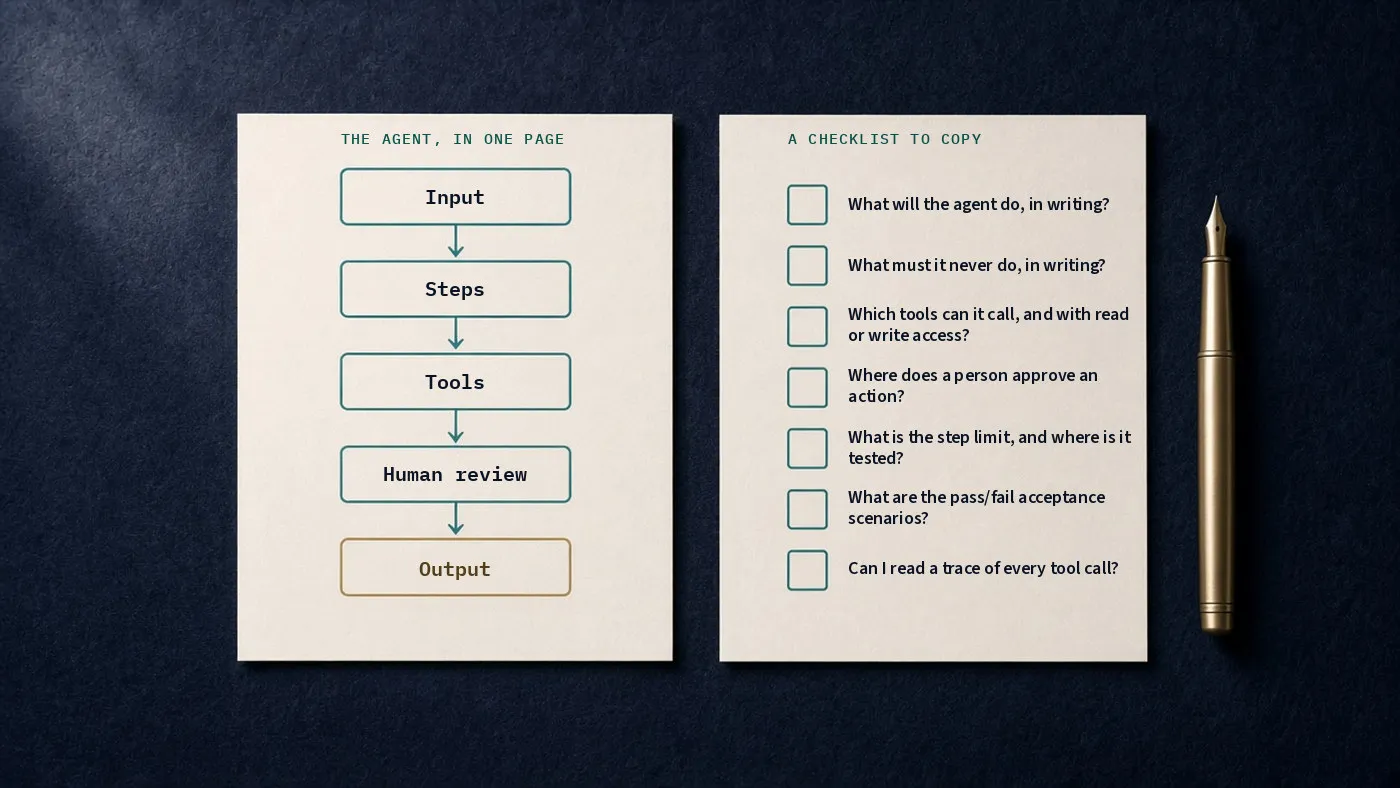
A checklist to copy
Bring this list to your first call with any builder:
- Could a simpler system, such as an FAQ bot or RAG, do this job?
- What will the agent do, in writing?
- What must it never do, in writing?
- Which tools can it call, and with read or write access?
- Where does a person approve an action?
- How does the design limit damage from hostile input?
- What is the step limit, and where is it tested?
- What are the pass/fail acceptance scenarios?
- Will I get a test set I can re-run after changes?
- Can I read a trace of every tool call?
- Is the price fixed, and how is extra work priced?
- When do I pay, and when do I get the code?
- What runbook and bugfix period come with handoff?
Sources
- Anthropic, "Building effective agents": https://www.anthropic.com/engineering/building-effective-agents
- OWASP Gen AI Security Project, "LLM06:2025 Excessive Agency": https://genai.owasp.org/llmrisk/llm062025-excessive-agency/
- OWASP Gen AI Security Project, "LLM01:2025 Prompt Injection": https://genai.owasp.org/llmrisk/llm01-prompt-injection/
- Harbor Artificial packages: https://harborartificial.com/packages/
- Harbor Artificial, How we work: https://harborartificial.com/how-we-work/
Harbor Artificial is not Harbor Cloud, tryharbor.ai, or Protected Harbor. We refuse HIPAA/clinical work, regulated finance systems of record, realtime voice, and open-ended founding-engineer retainers.
FAQ
Guide FAQ
Do I need an AI agent, or would a simpler system do the job?
Ask the builder that first. Anthropic advises teams building with LLMs to start by "finding the simplest solution possible, and only increasing complexity when needed," which "might mean not building agentic systems at all." An FAQ bot answers known questions and passes the rest to a person. RAG answers questions from your own documents and shows the source. An agent fits a multi-step task across tools. Source: https://www.anthropic.com/engineering/building-effective-agents
What is Excessive Agency, and what should I ask about it?
The OWASP Top 10 for LLM Applications uses the name for the flaw "that enables damaging actions to be performed in response to unexpected, ambiguous or manipulated outputs from an LLM." Its three root causes are "excessive functionality; excessive permissions; excessive autonomy." So ask whether the agent has only the tools it needs, whether each tool has only the access it needs, and whether the agent asks a person before a high-impact action. Source: https://genai.owasp.org/llmrisk/llm062025-excessive-agency/
Does a good system prompt stop prompt injection?
No. OWASP warns that indirect prompt injection happens "when an LLM accepts input from external sources, such as websites or files," and notes that RAG and fine-tuning "do not fully mitigate prompt injection vulnerabilities." A good answer from a builder points back to limited tools, limited permissions, and human approval. Source: https://genai.owasp.org/llmrisk/llm01-prompt-injection/
What are acceptance scenarios?
A set of scenarios with expected outcomes, written down before the build. Each one passes or fails. When the build is done, you run them. If they pass, the work is accepted. A scenario added later is new work.
Which answers from a builder are red flags?
"It can do anything." "We will figure out scope as we go." "The model is smart enough to stay safe." "We guarantee no hallucinations." Also watch for no written list of what is out of scope, no acceptance scenarios before the build starts, and no logs or traces you can read.
Want to see if a package fits?
Share what you’re trying to ship, your timing, and any constraints you already know. We’ll reply from hello@harborartificial.com.